
The Temporal Gap: Why QoE Audits the Past, but QoT™ Audits the Future
In the world of Lower Middle Market (LMM) Private Equity, the Quality of Earnings (QoE) report is the undisputed king of the data room. It is the financial “Source of Truth,” meticulously peeling back the layers of a company’s historical performance to find the “true” EBITDA.
But as the investment landscape shifts toward “Buy, Build, and Hold” strategies, a dangerous gap has emerged. Investors are increasingly realizing that while a QoE tells you how a company got here, it is fundamentally incapable of telling you if the company can get there.
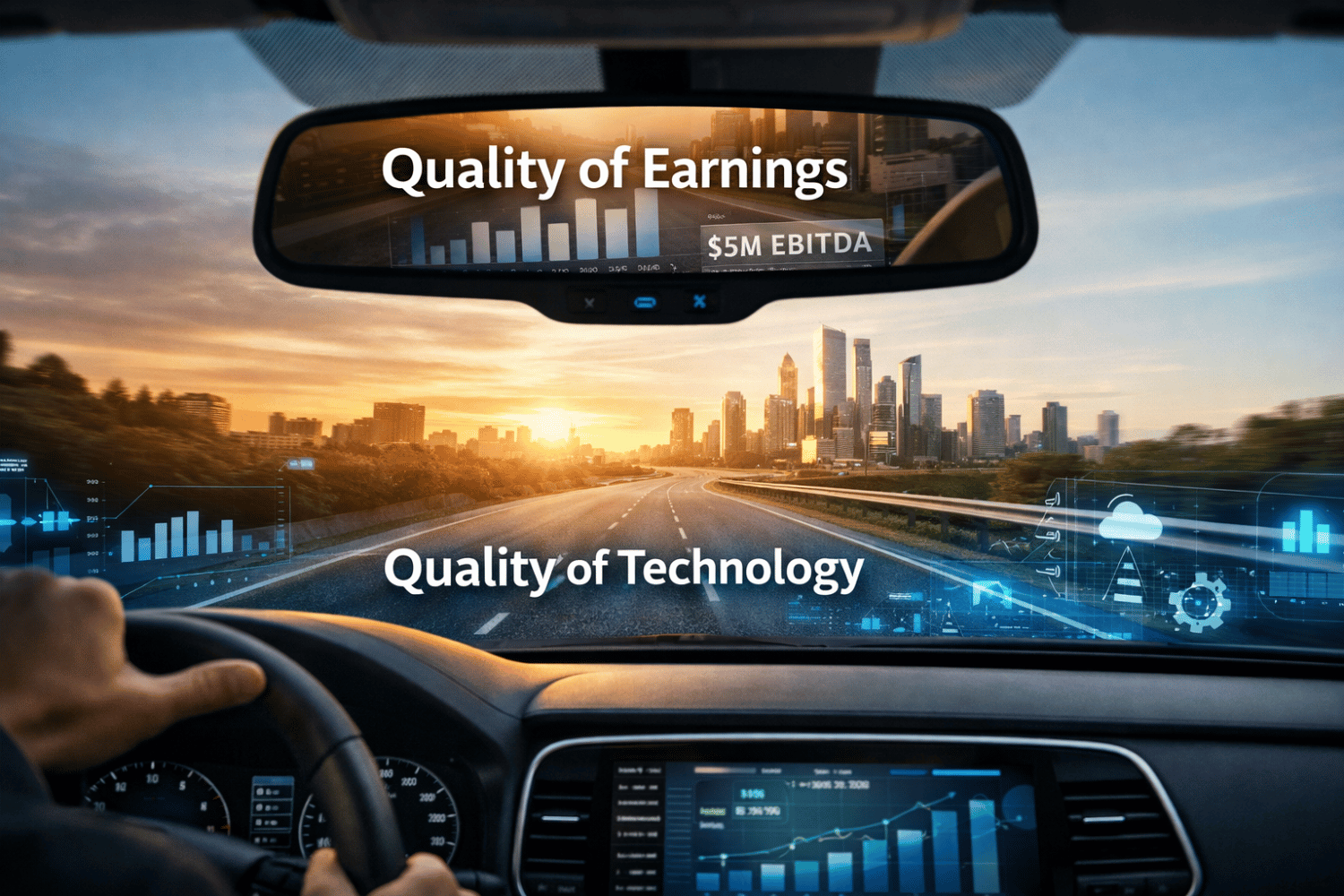
To bridge this gap, sophisticated firms are turning to Quality of Technology (QoT™)—the forward-looking mirror to the QoE’s rearview lens
QoE: The Rearview Mirror (Historical Truth)
The QoE is an exercise in forensic accounting. Its primary mission is to validate that the revenue claimed in the past actually occurred and that the expenses were properly categorized. It looks at:
- Historical Accuracy: Did the company actually earn $5M in EBITDA last year?
- Revenue Persistence: Are these customers recurring or one-time?
- Working Capital: What was the historical cash requirement to run the business?
The QoE is essential for valuation based on what exists. However, it operates on a “Snapshot in Time” philosophy. It assumes that if the pipes worked yesterday, they will work tomorrow.
QoT™: The Windshield (Forward-Looking Defensibility)
If the QoE is the rearview mirror, the QoT™ is the windshield. It doesn’t care how much you spent on servers last year; it cares how much you’ll have to spend next year to support a 3x growth mandate.
QoT™ evaluates the integrity of the growth engine. It asks:
- · Scalability: The QoE says you handled 10,000 users last year. The QoT™ reveals the system will crash at 15,000.
- Technical Debt: The QoE sees a low-cost engineering team as a margin win. The QoT™ sees it as a “Multiple-Killer” because that team hasn’t documented a single line of code in three years.
- Integration Velocity In a “Build” strategy, the QoE cannot tell you if the target’s software can absorb three bolt-on acquisitions. The QoT™ identifies the lack of an API layer as a $1.5M “tax” on your future IRR
The Financial Bridge: Where Past and Future Meet
The true power of the IT Ally framework is the QoT™-to-QoE Bridge. This is the point where technical findings are translated into financial reality.
When a QoT™ diagnostic identifies a Tier 3 (Stabilization Required) asset, it provides the Investment Committee with “Auditable Adjustments”:
1. The CapEx Deduction: A forward-looking cost for re-platforming that must be subtracted from the purchase price today.
2. The OpEx Normalization: The realization that the “lean” historical IT spend was actually an “under-investment” that must be corrected to protect the hold period.
Conclusion: Investing in the “Next” 10 Years
For firms like CPS Capital that operate on a “Buy, Build, and Hold” philosophy, the historical truth of a QoE is insufficient. You aren’t just buying the earnings of the last three years; you are buying the capacity to generate earnings for the next ten.
By institutionalizing QoT™ alongside QoE, investors stop “hoping” the technology works and start architecting its success. In the LMM, the past is a data point, but the technology is the destiny.
Is your diligence looking backward or forward?
FAQs
What is the difference between Quality of Earnings (QoE) and Quality of Technology (QoT)™?
QoE validates historical financial performance, while QoT™ evaluates whether a company’s technology can support future growth, scalability, and integration.
Why isn’t QoE alone enough in private equity diligence?
QoE focuses on past performance, but it doesn’t assess system scalability, technical debt, or integration readiness—key factors that directly impact future returns.
What is Quality of Technology (QoT)™ in private equity?
QoT™ is a forward-looking diligence framework that analyzes infrastructure, software architecture, security, and scalability to determine if a business can meet growth targets.
How does technical debt affect valuation?
Technical debt increases future costs, slows integration, and introduces risk—often reducing EBITDA quality and lowering the company’s overall valuation multiple.
What is the QoT™-to-QoE bridge?
It’s the process of translating technical findings into financial impact, such as CapEx requirements and OpEx adjustments, giving investors a clearer picture of true deal value.

