
Developing a Post-Acquisition Technology Roadmap for LMM Portfolio Companies
What would change if your post-close technology plan behaved less like cleanup and more like a growth engine? In the lower-middle market, Day 1 through Day 365 set the tone for value creation. You inherit fragmented systems, tribal processes, and just enough technical debt to stall your thesis. A disciplined post-acquisition technology roadmap turns that chaos into an operating system: one that stabilizes the core, unlocks data, and creates a platform for automation, analytics, and agentic AI across the portfolio.
Short Summary
- Start with the value thesis, not the tool list. Tie the roadmap directly to EBITDA, working capital, and revenue levers the deal depends on.
- Sequence work in three horizons. Stabilize–Secure–See in the first 100 days; Standardize–Integrate–Optimize in the next 6–18 months.
- Invest early in a data and integration spine. One source of truth for customers, products, and financials makes every future project cheaper and faster.
- Embed security from Day 1. A basic but consistent security baseline de-risks the story for lenders, regulators, and future buyers.
- Use agentic AI and automation in tight boxes. Deploy copilots and bots around bounded workflows once foundations are in place.
- Run a clear cadence. A simple governance rhythm keeps technology aligned with the investment thesis instead of becoming an internal science project.
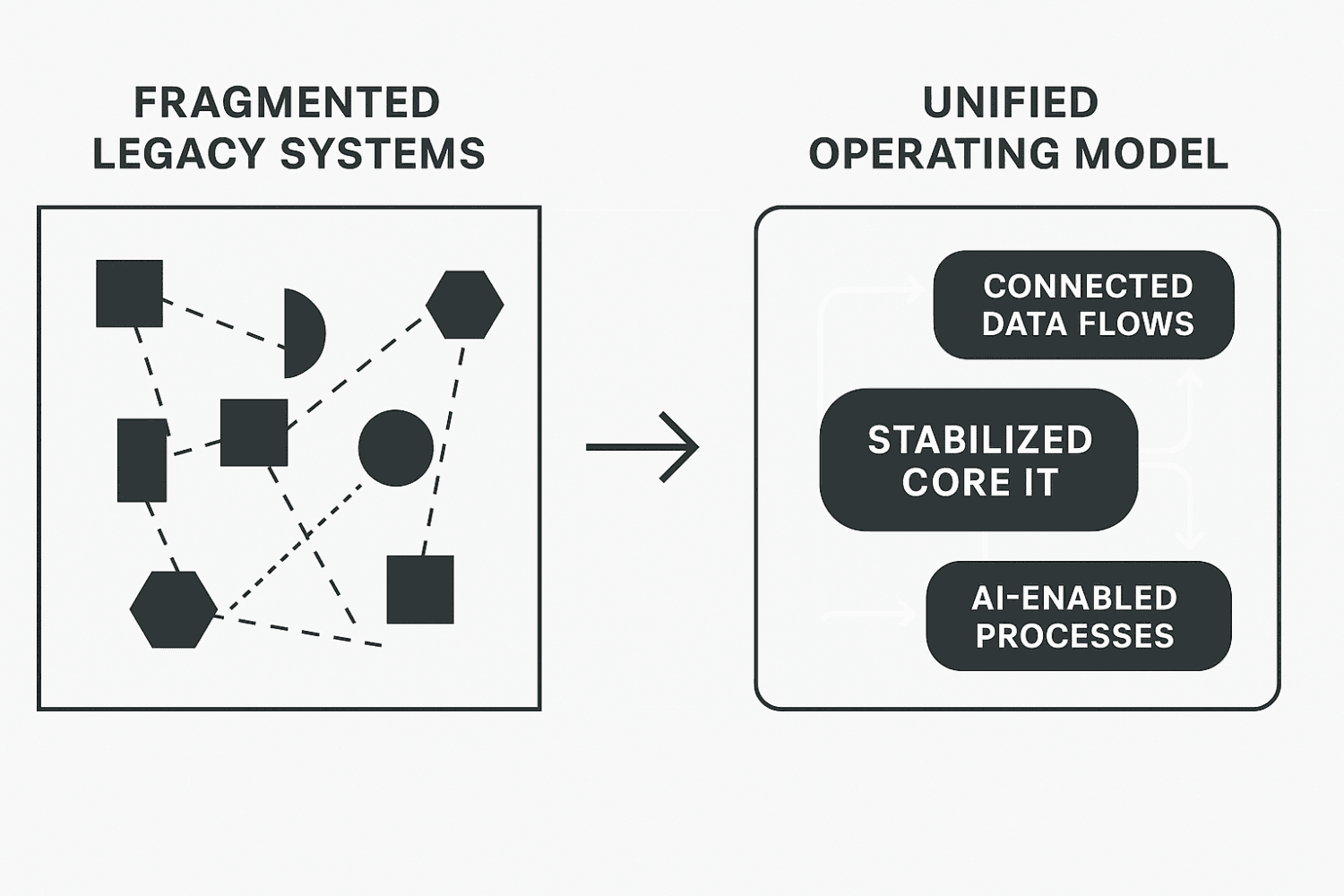
From “IT Cleanup” to Value-Creation Roadmap
Most post-acquisition technology work starts reactively: fix the outages, renew the licenses, calm the users. Necessary, but not sufficient. In LMM PE, you can’t afford a year of “stabilization” before you start creating value. The roadmap has to do both: keep the lights on while you quietly rewire the building.
That shift starts by rewriting the question. Instead of “What systems do we have to fix?” ask, “What specific financial outcomes must this company deliver, and which technology capabilities make them reliable?” If your thesis leans on margin expansion, you will focus on pricing discipline, throughput, and scrap. If it leans on revenue growth, you will emphasize pipeline visibility, quote speed, and upsell. The roadmap is simply the ordering of those capabilities over time.
Step 1 (Days 1–30): Rapid Technology Assessment with Investor Eyes
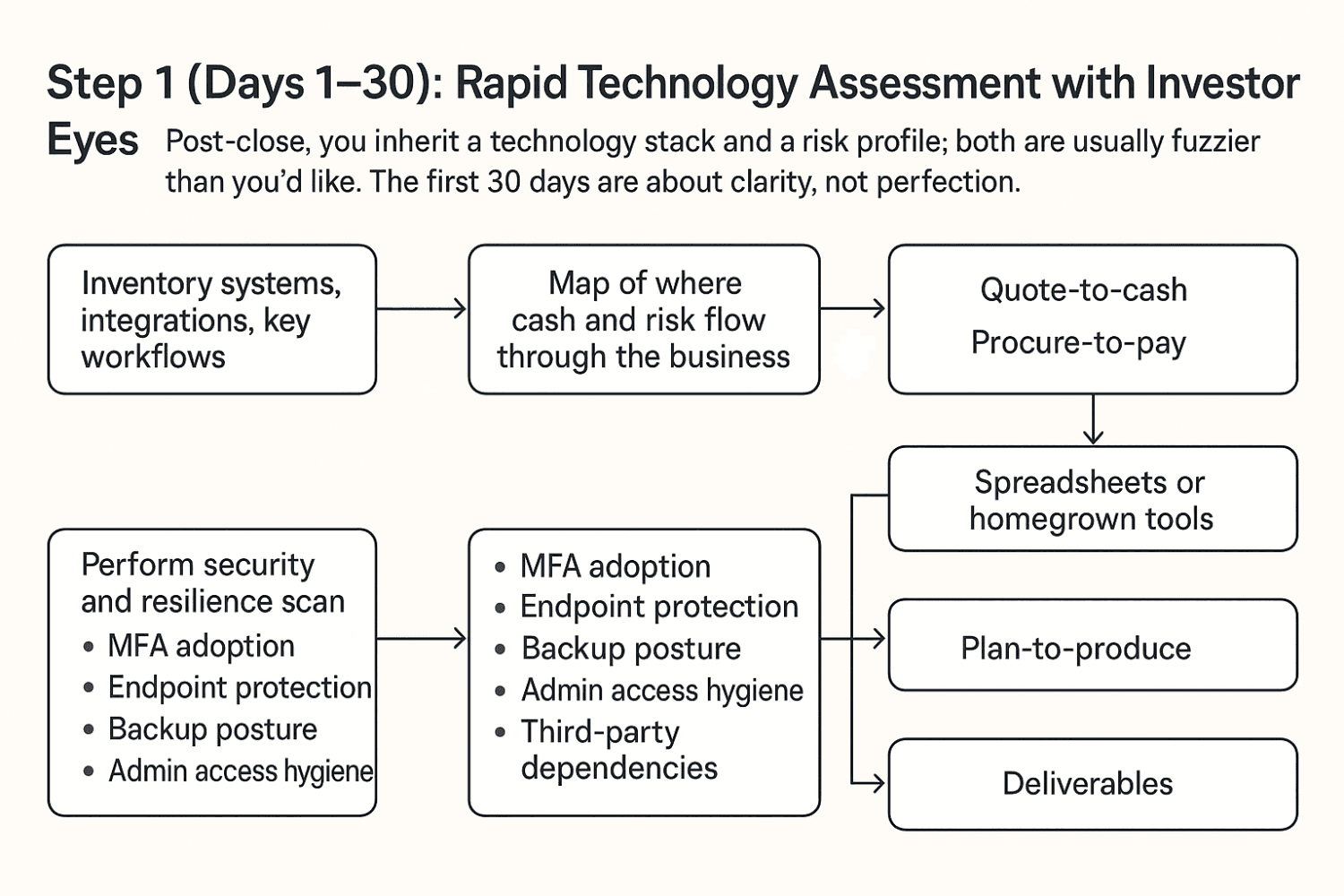
Post-close, you inherit a technology stack and a risk profile; both are usually fuzzier than you’d like. The first 30 days are about clarity, not perfection.
You start by inventorying systems, integrations, and key workflows—not as an academic exercise, but as a map of where cash and risk flow through the business. Which applications actually run quote-to-cash, procure-to-pay, and plan-to-produce? Where do spreadsheets or homegrown tools fill the gaps? Which reports does leadership rely on, and how are they produced?
At the same time, you perform a quick but pointed security and resilience scan: MFA adoption, endpoint protection, backup posture, admin access hygiene, and third-party dependencies. The goal is not a 100-page report; it’s a short list of high-impact remediation items you’ll tackle in the first 100 days so nothing derails value creation.
By the end of this step, you should have three artifacts: a technology landscape map, a list of top operational and reporting pain points, and a concise security risk summary. Those become the raw material for the roadmap.
Step 2 (Days 30–60): Align the Roadmap with the Value Thesis
With the landscape visible, you translate the deal thesis into a simple technology mandate. If your investment case rests on margin expansion, technology must enable price realization, waste reduction, and labor productivity. If the thesis focuses on growth, the emphasis shifts to funnel management, cross-sell visibility, and customer experience. If working-capital release is central, analytics and automation must compress DSO, tune inventory, and make AP/AR more touchless.
This is where you define the KPI spine: the handful of metrics that matter for this company in this hold period. DSO and OTIF, quote cycle time and win rate, contribution margin and scrap rate, churn and expansion revenue—whatever mix supports the thesis. Each line in the roadmap should explicitly state which of those metrics it is designed to move and how you will measure that movement.
When you do this well, the technology roadmap becomes legible to the board. It is not “Phase 1: New CRM, Phase 2: Data Lake.” It is, “Phase 1: Reduce DSO by seven days and raise OTIF to 95%; Phase 2: Improve realized price by 100 bps and compress quote cycle time by 25%—supported by specific system changes.”
Step 3 (Days 60–100): Stabilize, Secure, See
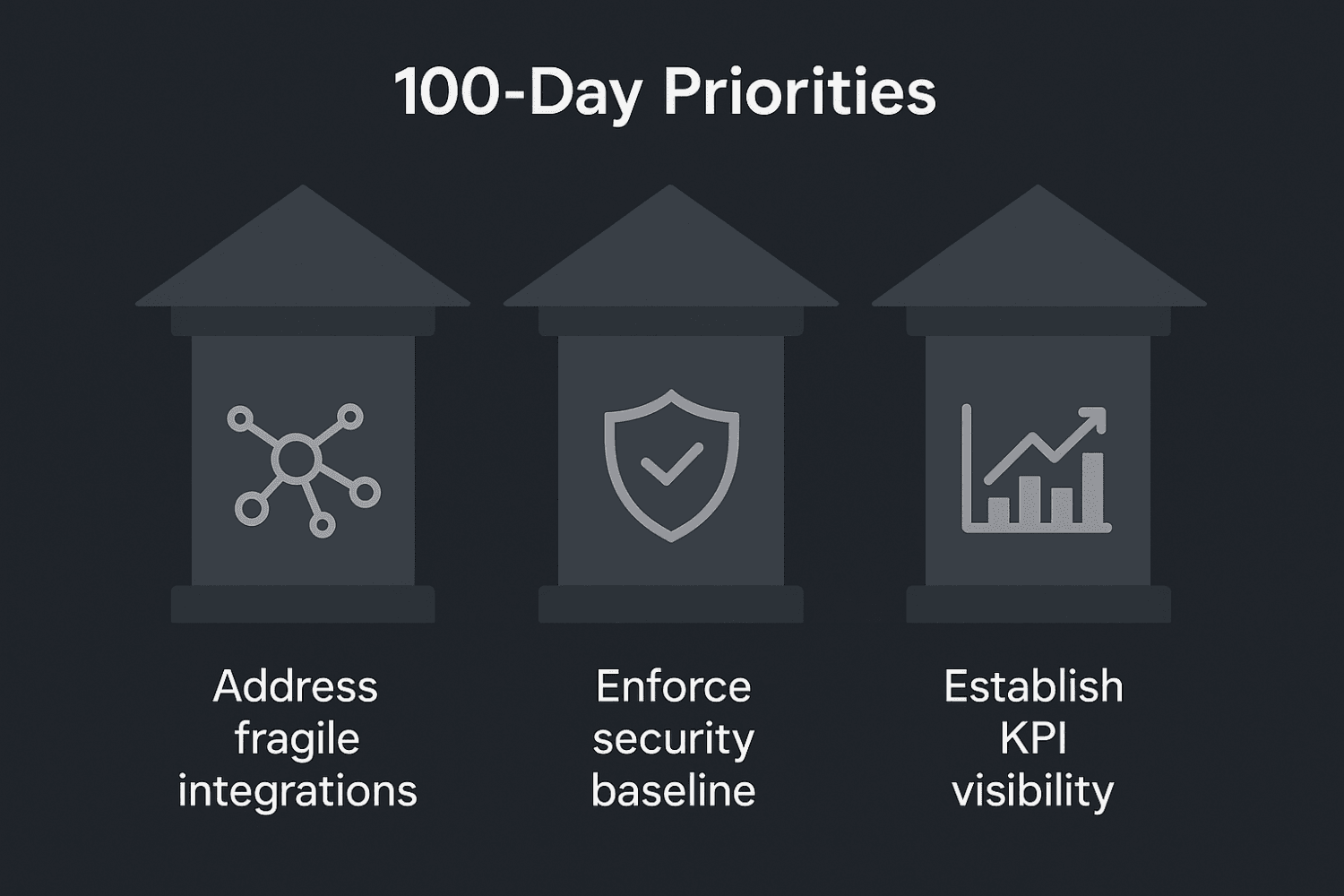
The first 100 days of the roadmap should be ruthlessly pragmatic. You are not building the future state yet; you are creating the conditions to build it safely and with confidence.
“Stabilize” means addressing the most fragile points in the current stack: the integration that fails every month-end, the manual spreadsheet that hides critical pricing logic, the server that hasn’t been patched in years. You fix just enough to reduce fire drills and create predictable operating conditions.
“Secure” is the security baseline. Even in a lean LMM context, you can enforce MFA, deploy endpoint detection and response, harden admin accounts, confirm backup integrity, and clarify who owns vendor risk. These are not optional; they are the minimum that lenders, insurers, and future buyers will assume.
“See” is about visibility. You choose one or two core value streams—usually quote-to-cash and procure-to-pay—and create daily or weekly dashboards tied to your KPI spine. Data quality will not be perfect, and that’s fine. The purpose is to establish line of sight so that upcoming changes can be evaluated in real time rather than by anecdote.
By Day 100, leadership should feel fewer surprises, understand their metrics, and see a clear line from the roadmap to the thesis.
Step 4 (Months 4–12): Standardize, Integrate, Optimize
With the foundation in place, the roadmap shifts from triage to design.
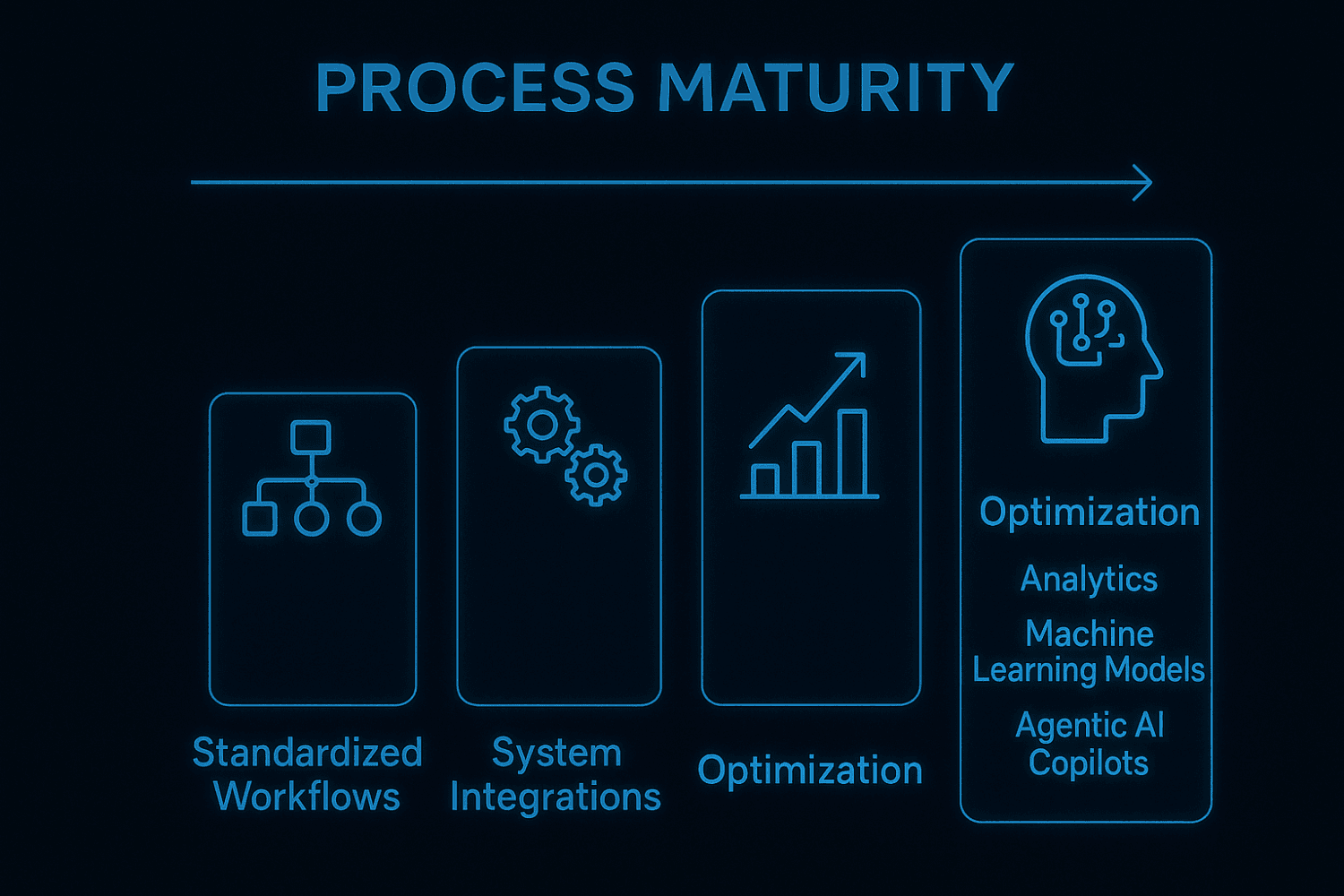
“Standardize” means defining how the company wants to sell, buy, fulfill, and support customers—and encoding that into systems and processes. You rationalize duplicate tools where they don’t add strategic value. You establish standard workflows in ERP, CRM, and service systems so that data is captured consistently and reporting becomes reliable.
“Integrate” is about flow. You focus on integrations that shorten cycle time and reduce errors: orders flowing cleanly from CRM to ERP, inventory signals from the floor feeding planning, billing driven directly by shipped and accepted work. The integration agenda is not “connect everything to everything”; it is “connect enough to make the business run like one organism.”
“Optimize” is where analytics and automation deepen impact. Once processes are standard and data is flowing, you can layer in targeted ML models, pricing guidance, demand forecasts, and agentic AI copilots that assist with quoting, scheduling, and support. The key is to keep these use cases bounded and tightly linked to your KPIs: a copilot that cuts quote time and improves realized price, not a platform initiative looking for a problem.
Over this period, the roadmap should begin to reference multi-quarter ambitions: a consistent customer 360, a portfolio-ready data model, and playbooks for bolt-on integrations.
Building the Data and Integration Spine
Every post-acquisition roadmap needs a quiet hero: a data and integration spine that outlives individual systems. LMM companies rarely need a full-blown lakehouse to win; they do need a reliable way to answer basic questions:
- Who are our customers, and what have we sold them?
- Which SKUs or services are driving margin and where is it leaking?
- How is cash moving through the system, from order to payment?
To answer these consistently, you invest in a modest but durable layer that standardizes customers, products, vendors, and chart-of-accounts across your core systems. It might be a lightweight master data management tool, or a well-governed set of tables in your analytics environment. Either way, the roadmap assigns ownership, defines data-quality expectations, and sets a cadence for maintaining them.
Integrations are then routed through this spine. New applications map to existing entities instead of inventing their own. When you eventually add agentic AI or advanced analytics, they sit on top of a structure that’s already trusted and documented, not on ad-hoc exports.
Cybersecurity and Resilience as Part of the Story, Not an Add-On
For many LMM businesses, cybersecurity is a quiet concern until an event forces it into the spotlight. A post-acquisition roadmap should treat security as a value enabler, not just a compliance checkbox. Buyers, lenders, and strategic partners increasingly ask hard questions about how data is protected, how incidents are handled, and whether basic hygiene is in place.
Your roadmap should outline a progression: first the baseline (MFA, EDR, backups, role-based access), then vulnerability management and patching discipline, then monitoring and incident response. The point is not to turn a mid-sized manufacturer into a bank. It’s to demonstrate that the business can operate reliably under scrutiny, and that technology-enabled growth is not creating unmanaged risk.
That same discipline underpins trustworthy AI and analytics. When you know where sensitive data lives, who has access, and how it’s used, you can confidently adopt agentic AI and automated decisioning in targeted areas without inviting unacceptable exposure.
Talent, Change, and the Human Side of the Roadmap
A technology roadmap is only as strong as the people who run it. Post-acquisition, you will encounter pockets of deep institutional knowledge, varying levels of process maturity, and legitimate fear of “being optimized away.”
Ignoring that reality is the fastest way to stall.
Your roadmap should specify not just systems and capabilities, but roles and skills. Where do you need a true technology leader versus a strong vendor manager? Which functions need power users who can translate between operations and IT? How will you train frontline staff when new workflows and tools arrive?
The most successful LMM roadmaps share two traits. First, they start small: one function, one value stream, one clear before-and-after story. Second, they make the change feel like relief. If a copilot drafts quotes, it does so in a way that removes drudgery and lets sales focus on relationships. If automation ingests invoices, finance gets time back for analysis instead of reconciliation.
By encoding change management into the roadmap—communications, training, early wins—you turn technology from something “done to” the organization into something people advocate for.
Governance and Cadence: Keeping Technology Aligned with the Thesis
Without governance, post-acquisition roadmaps drift. Pet projects creep in, vendors drive the agenda, and quarterly reports describe activity instead of outcomes. The fix is simple: a cadence that puts the investment thesis at the center.
At minimum, you want three layers:
The roadmap itself should be a living artifact. Items can move left or right on the timeline, but only with a clear explanation of how that affects the thesis. New initiatives are evaluated on the same basis as the original ones: which KPI do they move, over what horizon, with what level of confidence?
This discipline is what turns a technology roadmap into a credible part of the value-creation plan, rather than a cost center the board tolerates.
Summary
A post-acquisition technology roadmap for an LMM portfolio company is not a list of tools to buy—it is a sequence of capabilities that make the investment thesis real. In the first 100 days, you stabilize operations, secure the environment, and gain line of sight into the metrics that matter. Over the next 6–18 months, you standardize processes, integrate systems, and leverage data, automation, and agentic AI to drive growth and efficiency where it counts.
When each step is explicitly tied to EBITDA, working capital, and revenue levers, technology stops being background noise. It becomes the operating system of the business—and a central part of the story you tell when it’s time to exit.
FAQs
How detailed should a post-acquisition technology roadmap be?
Detailed enough that you can assign owners, budgets, and KPIs—but not so granular that it becomes a project plan. Think capabilities and milestones over 12–18 months, supported by rolling 90-day execution plans.
What if the company’s existing systems are outdated?
Stabilize and integrate before you replace. Clean the data that matters, standardize critical workflows, and prove value from better visibility and automation. Large-scale replacements belong later in the roadmap, once you’ve captured nearer-term wins.
Where do AI and advanced analytics fit?
They come after you’ve established a data and process foundation. Start with bounded use cases—quote assembly, demand forecasting, ticket triage—where you have clear systems of record and clear KPIs. Scale only what proves out in your environment.
How often should the roadmap be revisited?
At least quarterly at the strategic level, with 90-day execution plans refreshed monthly. The thesis doesn’t change often; the path to achieving it should adjust as you learn.

Michael Fillios
Michael C. Fillios is the founder and CEO of IT Ally, a business and technology advisory firm for family owned and private equity backed small- and medium-sized businesses (SMBs). He is a former Fortune 500 global CIO, small business CFO, technology entrepreneur and management consultant with more than 25 years of experience. His first book, Tech Debt 2.0®: How to Future Proof Your Small Business and Improve Your Tech Bottom Line, was published by the IT Ally Institute in April 2020. His new book is, Tech Equity, How to Future Ready Your Small Business and Outperform Your Competition (IT Ally Institute, May 4, 2023). Learn more at itallyllc.com.

